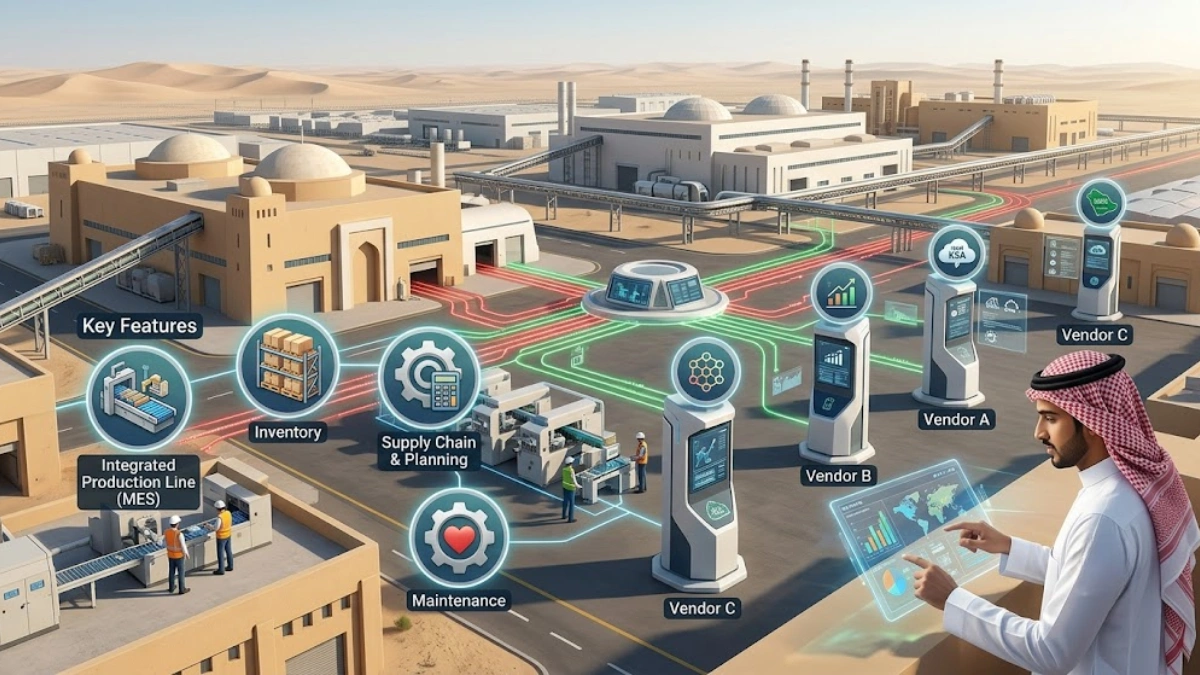
Saudi Arabia’s manufacturing sector is expanding rapidly as the country invests heavily in industrial development under Vision 2030. From food processing and chemicals to construction materials, packaging, and automotive production, manufacturers are modernizing operations with digital technologies.
One of the most important technologies transforming factories is ERP software. ERP (Enterprise Resource Planning) systems help manufacturing companies manage production, inventory, procurement, accounting, warehouses, suppliers, and reporting through one centralized platform.
For Saudi manufacturers, ERP software is becoming essential for improving efficiency, reducing operational costs, supporting ZATCA compliance, and managing increasingly complex supply chains. This guide explains the key ERP features manufacturing businesses need, the benefits of ERP implementation, and the top ERP vendors in Saudi Arabia.
Why Manufacturing Companies Need ERP Software
Manufacturing businesses handle multiple processes every day, including:
- Production planning
- Raw material management
- Procurement
- Inventory tracking
- Warehouse operations
- Supplier coordination
- Quality control
- Financial management
Without ERP software, companies often struggle with:
- Production delays
- Inventory shortages
- Manual reporting errors
- High operational costs
- Lack of real-time visibility
ERP systems automate these operations and provide centralized control across departments.
Key Features of Manufacturing ERP Systems
1. Production Planning and Scheduling
Production planning helps factories organize manufacturing operations efficiently.
ERP systems allow businesses to:
- Schedule production orders
- Track manufacturing timelines
- Monitor machine capacity
- Reduce production bottlenecks
- Improve workflow efficiency
Advanced ERP systems also include Material Requirements Planning (MRP), which ensures raw materials are available when needed.
2. Inventory and Warehouse Management
Inventory management is critical for manufacturing businesses.
Manufacturing ERP systems provide:
- Real-time inventory tracking
- Barcode scanning
- Batch and serial number tracking
- Warehouse transfers
- Automated stock updates
These features help reduce inventory shortages and improve warehouse efficiency.
3. Bill of Materials (BOM) Management
BOM management tracks all components and materials needed to manufacture products.
ERP systems help manufacturers:
- Create multi-level BOM structures
- Calculate production costs
- Manage product revisions
- Reduce material waste
This improves production accuracy and cost control.
4. Procurement and Supplier Management
ERP systems simplify procurement processes by automating:
- Purchase orders
- Supplier approvals
- Goods receipt tracking
- Vendor management
- Procurement planning
This helps manufacturers improve supplier coordination and avoid production delays.
5. Quality Control Management
Quality management is extremely important for industries like food manufacturing, pharmaceuticals, and chemicals.
ERP quality modules help businesses:
- Track inspections
- Record product defects
- Monitor compliance standards
- Improve product traceability
- Manage corrective actions
This helps companies maintain consistent product quality.
6. Financial Management and Cost Accounting
Manufacturing ERP systems include advanced accounting tools.
Key financial features include:
- Production costing
- VAT reporting
- Budget management
- Profitability analysis
- Expense tracking
Saudi businesses also require ERP systems that support ZATCA e-invoicing and VAT compliance.
7. Plant Maintenance Management
Machine downtime can reduce factory productivity and increase costs.
ERP maintenance modules support:
- Preventive maintenance scheduling
- Equipment monitoring
- Spare parts management
- Maintenance work orders
- Downtime reporting
These features help factories improve equipment reliability.
8. Real-Time Analytics and Reporting
Manufacturing companies need accurate reports for better decision-making.
ERP dashboards provide:
- Production reports
- Inventory status
- Financial analytics
- Sales forecasting
- Operational performance metrics
Real-time visibility improves efficiency and business planning.
Benefits of ERP for Manufacturing Companies
| Benefit | Description |
|---|---|
| Improved Production Efficiency | Automates workflows and reduces delays |
| Better Inventory Control | Tracks stock levels in real time |
| Lower Operational Costs | Reduces manual work and errors |
| Faster Reporting | Generates instant business reports |
| Better Quality Control | Improves product consistency |
| Supply Chain Optimization | Enhances supplier coordination |
| Regulatory Compliance | Supports VAT and ZATCA requirements |
| Scalability | Supports future business expansion |
Cloud ERP vs On-Premise ERP
Cloud ERP
Cloud ERP systems are hosted online and accessed through the internet.
Advantages
- Lower upfront investment
- Faster implementation
- Remote accessibility
- Automatic updates
Disadvantages
- Ongoing subscription costs
- Internet dependency
On-Premise ERP
On-premise ERP is hosted on the company’s own servers.
Advantages
- Greater control over infrastructure
- Advanced customization options
Disadvantages
- Higher hardware costs
- Expensive maintenance
- Longer deployment time
Many Saudi SMEs now prefer cloud ERP because of lower infrastructure expenses.
Top ERP Vendors for Manufacturing Companies in Saudi Arabia
1. SAP S/4HANA
SAP is one of the most widely used ERP systems among large manufacturers.
| Feature | Details |
|---|---|
| Best For | Large manufacturing enterprises |
| Deployment | Cloud & On-Premise |
| Key Strength | Advanced manufacturing management |
| Industry Focus | Industrial production, oil & gas |
Advantages
- Strong supply chain management
- Real-time analytics
- Advanced production planning
- Enterprise scalability
Disadvantages
- High implementation cost
- Complex deployment process
2. Microsoft Dynamics 365
Microsoft Dynamics 365 is popular among mid-sized manufacturers.
| Feature | Details |
|---|---|
| Best For | Mid-sized manufacturers |
| Deployment | Cloud-Based |
| Key Strength | Microsoft ecosystem integration |
| Industry Focus | Manufacturing, retail, distribution |
Advantages
- User-friendly dashboards
- Flexible deployment
- Good MRP functionality
Disadvantages
- Licensing complexity
- Customization costs
3. Oracle ERP Cloud
Oracle provides enterprise-level ERP solutions for complex manufacturing environments.
| Feature | Details |
|---|---|
| Best For | Large enterprises |
| Deployment | Cloud |
| Key Strength | Enterprise scalability |
| Industry Focus | Industrial manufacturing |
Advantages
- Advanced financial management
- Strong analytics
- Global business support
Disadvantages
- Expensive implementation
- Requires experienced consultants
4. SAP Business One
SAP Business One is designed for SMEs and growing manufacturers.
| Feature | Details |
|---|---|
| Best For | Small & medium manufacturers |
| Deployment | Cloud & On-Premise |
| Key Strength | Affordable SAP ecosystem |
| Industry Focus | SMEs |
Advantages
- Easier implementation
- Strong inventory management
- Lower cost than SAP S/4HANA
Disadvantages
- Limited enterprise features
- Smaller scalability
5. Odoo Manufacturing ERP
Odoo is a flexible open-source ERP solution for budget-conscious businesses.
| Feature | Details |
|---|---|
| Best For | SMEs and startups |
| Deployment | Cloud & On-Premise |
| Key Strength | Modular flexibility |
| Industry Focus | Small manufacturing businesses |
Advantages
- Affordable pricing
- Easy customization
- Large app ecosystem
Disadvantages
- Requires technical expertise
- Heavy customization may affect stability
6. Infor CloudSuite Industrial
Infor focuses heavily on manufacturing ERP capabilities.
| Feature | Details |
|---|---|
| Best For | Industrial manufacturers |
| Deployment | Cloud |
| Key Strength | Manufacturing automation |
| Industry Focus | Industrial production |
Advantages
- Strong production planning
- Shop-floor automation
- Maintenance management
Disadvantages
- Expensive for smaller businesses
- Complex implementation
How to Choose the Right Manufacturing ERP
Evaluate Business Size
Large factories usually require SAP or Oracle, while SMEs often prefer Odoo or SAP Business One.
Check Industry Requirements
Different manufacturing industries require specialized workflows and production tools.
Ensure ZATCA Compliance
ERP systems should support:
- E-invoicing
- VAT reporting
- Arabic invoicing
- QR-code invoice generation
Analyze Total Cost
Businesses should calculate:
- Software licensing
- Implementation fees
- Training costs
- Maintenance expenses
Choose Experienced ERP Partners
Local implementation partners improve deployment success and post-launch support.
Common ERP Challenges in Manufacturing
Manufacturers may face several ERP implementation challenges:
- Poor planning
- Data migration issues
- Employee resistance
- Excessive customization
- Budget overruns
Proper project planning and employee training significantly improve ERP success rates.
FAQs
Which ERP is best for manufacturing companies in Saudi Arabia?
SAP, Oracle ERP, Microsoft Dynamics 365, SAP Business One, and Infor are among the leading ERP solutions for Saudi manufacturers.
Why do factories need ERP software?
ERP software helps factories automate production planning, inventory management, procurement, accounting, and reporting.
What is MRP in manufacturing ERP?
MRP (Material Requirements Planning) helps manufacturers manage raw materials, production schedules, and inventory efficiently.
Is cloud ERP suitable for manufacturing businesses?
Yes, cloud ERP provides lower upfront costs, remote accessibility, and easier scalability for many manufacturing companies.
Do manufacturing ERP systems support ZATCA compliance?
Most modern ERP platforms support ZATCA e-invoicing and VAT reporting requirements through integrated compliance tools.
How much does manufacturing ERP implementation cost in Saudi Arabia?
Costs vary depending on the ERP platform and project complexity. SME implementations may start around SAR 50,000, while enterprise projects can cost several million riyals.
Final Thoughts
ERP systems are becoming essential for manufacturing companies in Saudi Arabia as factories modernize operations and adopt digital transformation strategies.
Modern manufacturing ERP platforms provide:
- Production automation
- Inventory optimization
- Financial visibility
- Supply chain control
- Quality management
- Compliance support
Large enterprises often choose SAP or Oracle for advanced capabilities, while SMEs prefer SAP Business One, Odoo, or Microsoft Dynamics 365 because of lower implementation costs and flexibility.
The right ERP system can improve productivity, reduce operational costs, and help Saudi manufacturers achieve long-term growth in an increasingly competitive industrial market.