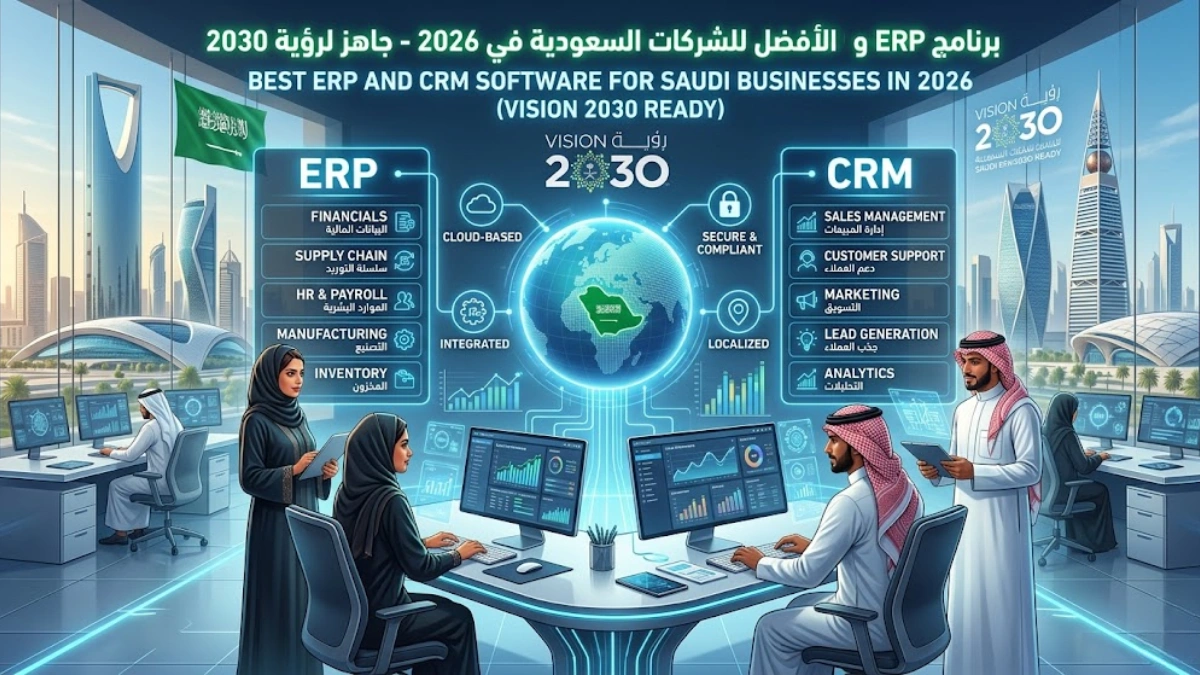
Saudi Arabia’s business landscape in 2026 is shaped by rapid digital transformation under Vision 2030, strict compliance frameworks like ZATCA e-invoicing, and increasing competition across retail, manufacturing, logistics, finance, and services.
To stay competitive, Saudi companies are investing heavily in ERP (Enterprise Resource Planning) and CRM (Customer Relationship Management) systems. These platforms are no longer optional they are essential for automation, efficiency, customer engagement, and growth.
Modern businesses in Saudi Arabia now prefer integrated ERP + CRM ecosystems that connect finance, operations, sales, and customer data in one unified system. This guide explores the best ERP and CRM software for Saudi businesses in 2026, along with a detailed comparison, features, benefits, and industry use cases.
Why ERP and CRM Matter for Saudi Businesses in 2026
Saudi businesses face new challenges such as:
- VAT and ZATCA compliance requirements
- Multi-branch operations
- Digital-first customers
- Increased competition in GCC markets
- Demand for real-time business insights
ERP and CRM systems solve these challenges by:
- Automating operations
- Improving customer relationships
- Reducing manual errors
- Increasing productivity
- Supporting data-driven decisions
ERP vs CRM (Simple Explanation)
- ERP Software manages internal operations (finance, inventory, HR, supply chain)
- CRM Software manages customer relationships (sales, marketing, support)
When combined, they create a fully connected business ecosystem.
Best ERP Software for Saudi Businesses (2026)
Top ERP Platforms Comparison Table
| ERP Software | Best For | Deployment | Strength | Pricing Level |
|---|---|---|---|---|
| SAP S/4HANA | Large enterprises & government | Cloud / On-premise | Enterprise-grade operations | Very High |
| Microsoft Dynamics 365 | Mid & large enterprises | Cloud / Hybrid | Microsoft integration + AI | High |
| Oracle NetSuite | Growing businesses & SMEs | Cloud | Scalable cloud ERP | High |
| Odoo ERP | SMEs & startups | Cloud / On-premise | Flexible modular system | Low–Medium |
1. SAP S/4HANA (Enterprise Leader in Saudi Arabia)
SAP is widely used by large Saudi organizations, especially in government, oil & gas, and manufacturing.
Key Features
- Advanced financial management
- Supply chain optimization
- Real-time analytics
- Industry-specific modules
- Strong compliance support
Why Businesses Choose SAP
- Extremely powerful ERP system
- Suitable for large-scale operations
- Strong global compliance standards
Limitations
- Very expensive
- Complex implementation
- Requires expert consultants
2. Microsoft Dynamics 365 (Most Popular Enterprise ERP)
Microsoft Dynamics 365 is widely adopted in Saudi Arabia due to strong integration with Microsoft tools.
Key Features
- Finance and operations management
- AI-powered analytics
- Power BI dashboards
- HR and supply chain modules
- CRM integration
Advantages
- Seamless Microsoft ecosystem integration
- Flexible cloud deployment
- Strong analytics and reporting
Limitations
- Licensing complexity
- Requires technical setup
3. Oracle NetSuite (Cloud ERP Leader)
NetSuite is a cloud-first ERP system widely used by growing businesses.
Key Features
- Financial management
- Inventory control
- CRM integration
- Global scalability
Advantages
- Fully cloud-based
- Easy scalability
- Strong reporting tools
Limitations
- Expensive for large scale usage
- Requires localization for Saudi compliance
4. Odoo ERP (Best for SMEs in Saudi Arabia)
Odoo is one of the fastest-growing ERP systems in Saudi SMEs.
Key Features
- Modular ERP system
- CRM + accounting integration
- Inventory and sales management
- Arabic support
Advantages
- Affordable
- Highly customizable
- Strong SME ecosystem
Limitations
- Requires technical configuration
- Performance depends on setup
Best CRM Software for Saudi Businesses (2026)
CRM Comparison Table
| CRM Software | Best For | Strength | Arabic Support | Pricing |
|---|---|---|---|---|
| Salesforce | Large enterprises | Advanced AI & automation | Medium | Very High |
| Zoho CRM | SMEs | Affordable + full ecosystem | Strong | Low |
| HubSpot CRM | Startups & marketing teams | Easy marketing automation | Limited | Medium |
| Microsoft Dynamics CRM | Enterprises | ERP + CRM integration | Strong | High |
1. Salesforce CRM (Enterprise CRM Leader)
Salesforce remains the most powerful CRM platform globally.
Key Features
- AI-driven sales forecasting
- Advanced automation tools
- Customer analytics dashboards
- Marketing cloud integration
Advantages
- Highly scalable
- Enterprise-grade features
- Strong integration ecosystem
Limitations
- Expensive
- Complex implementation
2. Zoho CRM (Best Value for Saudi SMEs)
Zoho CRM is widely used in Saudi Arabia due to affordability and Arabic-friendly features.
Key Features
- Sales automation
- WhatsApp integration
- Lead tracking
- CRM + accounting ecosystem
Advantages
- Affordable pricing
- Strong Arabic support
- Easy integration with VAT-compliant Zoho Books
Limitations
- Limited enterprise-level features
3. HubSpot CRM (Marketing-Focused CRM)
HubSpot is widely used by startups and digital marketing teams.
Key Features
- Email marketing automation
- Sales pipeline tracking
- Lead nurturing tools
- Free CRM option
Advantages
- Very easy to use
- Strong marketing features
- Fast deployment
Limitations
- Limited Arabic interface support
- Expensive scaling
4. Microsoft Dynamics CRM
Microsoft Dynamics offers strong CRM capabilities integrated with ERP systems.
Key Features
- Sales automation
- Customer service tools
- AI insights
- Power Platform integration
ERP vs CRM vs Integrated ERP+CRM
| Feature | ERP | CRM | ERP + CRM |
|---|---|---|---|
| Focus | Internal operations | Customer management | End-to-end business system |
| Data Type | Finance, HR, inventory | Leads, customers | Unified business data |
| Value | Efficiency | Revenue growth | Maximum ROI |
| Automation | Operations | Sales & marketing | Full business automation |
Key Features Saudi Businesses Must Look For
1. ZATCA Compliance
- E-invoicing
- VAT reporting
- QR code invoices
2. Arabic Language Support
- RTL interface
- Arabic dashboards
- Localized workflows
3. Cloud Deployment
- Remote access
- Scalability
- Lower IT costs
4. WhatsApp Integration
Essential for Saudi sales communication.
5. AI-Powered Automation
- Predictive analytics
- Smart dashboards
- Automated workflows
Industry Use of ERP and CRM in Saudi Arabia
Retail & E-commerce
- Inventory + customer tracking
- Loyalty programs
- Marketing automation
Manufacturing
- Supply chain optimization
- Production planning
Real Estate
- Lead management CRM
- Property ERP systems
Banking & Finance
- Customer lifecycle management
- Risk analytics
Healthcare
- Patient management systems
- Appointment scheduling
Challenges in ERP and CRM Adoption
- High implementation cost
- Complex integration
- Employee training requirements
- Data migration challenges
- Resistance to digital change
Future of ERP and CRM in Saudi Arabia (Vision 2030)
By 2026 and beyond, ERP and CRM systems will evolve into:
- AI-powered business platforms
- Fully automated workflows
- Real-time government integration
- Predictive analytics systems
- Voice-enabled business assistants
Saudi Arabia is moving toward a fully digital enterprise ecosystem where ERP and CRM systems become the backbone of every organization.
FAQs
Which ERP is best for Saudi businesses in 2026?
SAP, Microsoft Dynamics, Oracle NetSuite, and Odoo are top choices.
Which CRM is best for SMEs in Saudi Arabia?
Zoho CRM is the most popular and cost-effective option.
Do ERP systems support ZATCA compliance?
Yes, modern ERP systems fully support VAT and e-invoicing requirements.
Can ERP and CRM be integrated?
Yes, most modern platforms support full integration.
Is cloud ERP better than on-premise?
Yes, cloud ERP is more scalable, flexible, and cost-efficient.
Final Thoughts
ERP and CRM systems are essential for Saudi businesses in 2026 as they transition toward a fully digital, AI-driven economy under Vision 2030.
Companies that invest in the right ERP and CRM combination will achieve:
- Higher operational efficiency
- Stronger customer relationships
- Better compliance management
- Smarter decision-making
- Long-term business scalability
In the coming years, integrated ERP and CRM platforms will define the success of Saudi businesses in an increasingly competitive and digital-first marketplace.