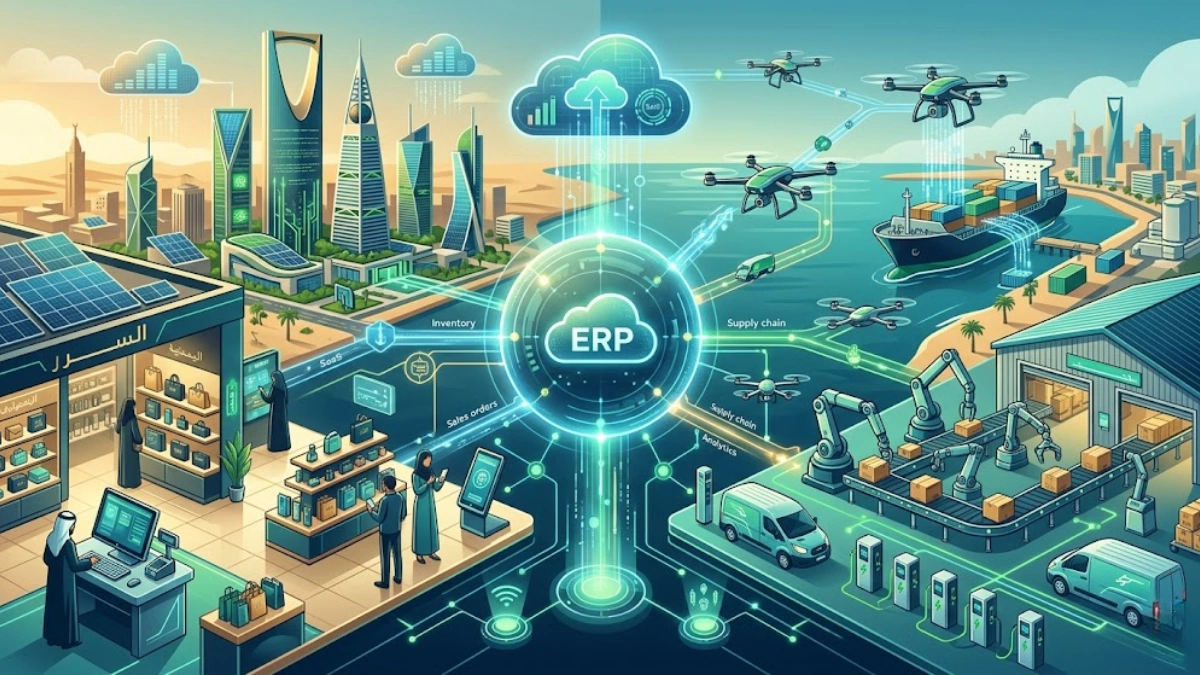
Saudi Arabia’s retail and e-commerce industry is experiencing rapid digital acceleration driven by Vision 2030, rising mobile commerce, and growing consumer demand for seamless online shopping experiences. In this evolving landscape, Cloud ERP SaaS solutions have become a critical backbone for modern businesses.
These systems help retailers unify operations, manage inventory in real time, automate accounting, and streamline omnichannel sales across physical stores and digital platforms. In 2026, adopting cloud ERP is no longer a luxury it is a competitive necessity for Saudi retail and e-commerce businesses.
What is Cloud ERP SaaS?
Cloud ERP SaaS (Software as a Service) is a cloud-based enterprise resource planning system delivered on a subscription model. It integrates multiple business functions into a single centralized platform, including:
- Inventory management
- Sales and order processing
- Accounting and finance
- Customer relationship management (CRM)
- Supply chain operations
- E-commerce integration
Unlike traditional ERP systems, SaaS-based ERP runs on the cloud, allowing businesses to access data anytime, anywhere without heavy infrastructure costs.
Why Saudi Retail Needs Cloud ERP in 2026
Saudi Arabia’s retail sector faces unique challenges such as rapid order fulfillment expectations, VAT compliance, and multi-channel operations. Cloud ERP SaaS helps solve these issues by offering real-time visibility and automation.
Key reasons for adoption:
- Rapid growth of e-commerce platforms
- Expansion of omnichannel retail models
- Strict VAT and ZATCA compliance requirements
- Increasing customer expectations for fast delivery
- Vision 2030 digital transformation initiatives
Key Features of Cloud ERP SaaS Solutions
Modern ERP SaaS platforms for Saudi retail include advanced features such as:
Inventory & Warehouse Management
Real-time stock tracking across multiple warehouses and stores.
Omnichannel Integration
Syncs offline stores, online shops, and marketplaces into one system.
Financial Automation
Automates VAT calculations, invoicing, payroll, and financial reporting.
AI-Powered Analytics
Provides predictive insights for demand forecasting and sales trends.
E-commerce Integration
Connects seamlessly with platforms like Shopify, Magento, and custom marketplaces.
Comparison Table: Cloud ERP vs Traditional ERP
| Feature | Traditional ERP | Cloud ERP SaaS |
|---|---|---|
| Deployment | On-premise servers | Cloud-based platform |
| Cost Structure | High upfront cost | Monthly subscription |
| Maintenance | IT team required | Managed by provider |
| Scalability | Limited | Highly scalable |
| Accessibility | Office-only access | Anywhere, anytime |
| Updates | Manual upgrades | Automatic updates |
| Compliance | Manual setup | Built-in VAT & ZATCA support |
| Integration | Complex | Easy API integration |
Cloud ERP SaaS clearly provides greater flexibility and efficiency for modern Saudi retail businesses.
Benefits for Saudi Retail & E-commerce Businesses
1. Real-Time Business Insights
Gain instant access to sales, inventory, and customer data.
2. Reduced Operational Costs
Eliminate expensive IT infrastructure and maintenance costs.
3. Improved Customer Experience
Faster order fulfillment and accurate stock availability improve satisfaction.
4. Scalability for Growth
Easily expand operations across multiple cities and regions.
5. Regulatory Compliance
Automated VAT and e-invoicing compliance reduces legal risks.
Challenges Solved by Cloud ERP
Without ERP SaaS, businesses often face:
- Inventory mismatches across channels
- Manual accounting errors
- Slow reporting and decision-making
- High operational inefficiency
- Poor customer experience
Cloud ERP eliminates these challenges by centralizing all operations.
Future of Cloud ERP in Saudi Arabia (2026 & Beyond)
The future of ERP systems in Saudi Arabia is strongly influenced by AI and automation technologies.
Upcoming trends include:
- AI-driven demand forecasting
- Automated pricing optimization
- Smart warehouse automation
- Blockchain-based transaction tracking
- Chatbot-integrated customer support
- Predictive supply chain management
As digital transformation accelerates, ERP SaaS adoption will become universal across Saudi retail and e-commerce sectors.
FAQs
1. What is Cloud ERP SaaS?
Cloud ERP SaaS is a subscription-based enterprise software hosted on the cloud that helps businesses manage inventory, sales, accounting, and operations in real time.
2. Why is Cloud ERP important for Saudi retail businesses?
It ensures real-time inventory tracking, VAT compliance, and seamless omnichannel operations, which are critical in Saudi Arabia’s fast-growing retail market.
3. Is Cloud ERP suitable for small e-commerce businesses in Saudi Arabia?
Yes. Cloud ERP is scalable and affordable, making it ideal for startups and SMEs as well as large enterprises.
4. Does Cloud ERP support Saudi VAT and e-invoicing?
Yes. Most modern ERP SaaS platforms include built-in compliance for Saudi VAT laws and ZATCA e-invoicing regulations.
Conclusion
Cloud ERP SaaS solutions are revolutionizing Saudi Arabia’s retail and e-commerce industry in 2026. By enabling real-time operations, improving customer experience, ensuring compliance, and supporting scalable growth, these platforms are becoming essential tools for modern businesses.
Retailers that adopt cloud ERP early will gain a strong competitive advantage in efficiency, profitability, and digital transformation aligned with Vision 2030.