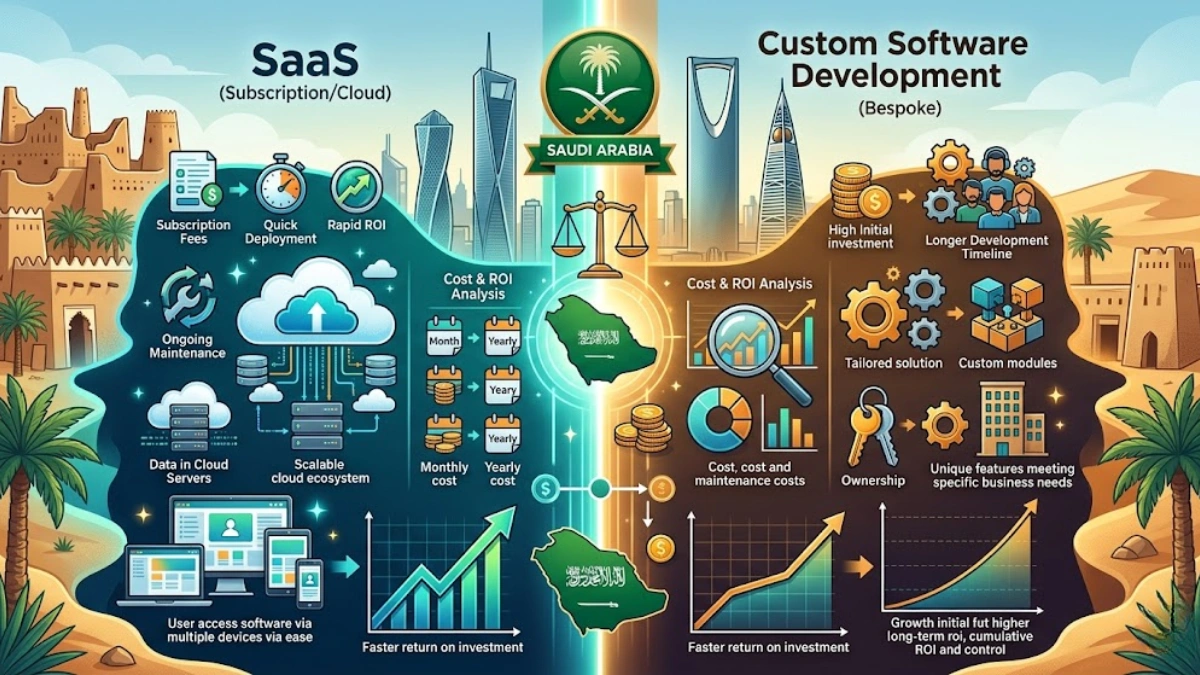
Saudi Arabia is rapidly advancing its digital economy under Vision 2030, pushing businesses toward smarter software adoption. Companies today face a major strategic decision: whether to use SaaS (Software as a Service) or invest in Custom Software Development.
Both models offer powerful advantages, but they differ in cost structure, flexibility, scalability, and long-term ROI. In industries like retail, e-commerce, logistics, healthcare, and fintech, choosing the right approach can significantly influence profitability and competitive advantage. This guide provides a complete cost and ROI breakdown tailored for Saudi businesses in 2026.
What is SaaS?
SaaS (Software as a Service) is cloud-based software delivered on a subscription model. Users access it online without installing or maintaining infrastructure.
Key Characteristics:
- Subscription-based pricing
- Fast deployment
- Vendor-managed updates
- Limited customization
- Scalable usage model
Popular SaaS tools include ERP systems, CRM platforms, accounting tools, and e-commerce integrations widely used in Saudi startups and SMEs.
What is Custom Software Development?
Custom software is built specifically for a business’s unique workflows and requirements. It is fully tailored and owned by the organization.
Key Characteristics:
- Fully customized features
- High upfront development cost
- Complete ownership of source code
- Scalable architecture
- Integration with internal systems
Large enterprises in Saudi Arabia often prefer custom software for competitive differentiation and long-term efficiency.
SaaS vs Custom Software: Detailed Comparison Table
| Feature | SaaS (Software as a Service) | Custom Software Development |
|---|---|---|
| Initial Cost | Low (subscription-based) | High upfront investment |
| Time to Launch | Days to weeks | Weeks to months |
| Ownership | Vendor-owned | Fully owned by business |
| Customization | Limited | Fully customizable |
| Maintenance | Managed by provider | Internal/outsourced team |
| Scalability | High but cost-based | Highly flexible architecture |
| Security | Provider-managed | Fully controlled by business |
| Integration | Standard APIs | Deep custom integration |
| Long-Term Cost | Increasing over time | Stable after development |
| ROI Timeline | Short-term ROI | Long-term ROI advantage |
This comparison clearly shows that SaaS is ideal for quick entry, while custom software is better for long-term strategic growth.
SaaS Cost Breakdown in Saudi Arabia
SaaS pricing depends on users, features, and subscription tiers.
- Monthly per user cost: SAR 150 – SAR 600
- Business software stack: SAR 5,000 – SAR 40,000/month
- Advanced integrations: additional charges
Estimated annual cost:
SAR 200,000 – SAR 450,000+ for mid-sized businesses
SaaS appears affordable initially but grows expensive as the business scales.
Custom Software Cost Breakdown in Saudi Arabia
Custom development requires higher initial investment but reduces dependency over time.
- Small systems: SAR 30,000 – SAR 75,000
- Medium enterprise systems: SAR 75,000 – SAR 200,000
- Large-scale platforms: SAR 200,000 – SAR 750,000+
Annual maintenance:
- SAR 10,000 – SAR 80,000 depending on complexity
Although expensive initially, custom software becomes cost-effective in the long run.
ROI Comparison: SaaS vs Custom Software
SaaS ROI Advantages
SaaS delivers faster ROI due to:
- Quick deployment
- No development time
- Low setup cost
- Ready-made features
However, ROI decreases over time because:
- Subscription costs grow with users
- Limited customization reduces efficiency
- Businesses may require multiple tools
Custom Software ROI Advantages
Custom software delivers stronger long-term ROI:
- No per-user subscription fees
- Better process automation
- Higher operational efficiency
- Competitive differentiation
Most businesses reach break-even in 2–4 years, after which custom software becomes significantly more profitable.
Key Benefits of SaaS
- Fast setup and deployment
- Low entry cost
- Easy scalability
- Vendor-managed maintenance
- Ideal for startups and SMEs
Key Benefits of Custom Software
- Fully tailored workflows
- Long-term cost efficiency
- Full ownership and control
- Strong integration capabilities
- Competitive market advantage
Hidden Costs to Consider
SaaS Hidden Costs:
- Increasing subscription fees
- Paid add-ons and upgrades
- Integration middleware costs
- Multiple tool dependencies
Custom Software Hidden Costs:
- Maintenance (15–25% annually)
- Hosting and infrastructure
- Developer salaries
- Upgrade cycles
Best Use Cases in Saudi Arabia
SaaS is best for:
- Startups and SMEs
- Quick market entry businesses
- Standard business processes
- Budget-conscious companies
Custom software is best for:
- Large enterprises
- Retail chains and logistics firms
- Fintech and banking systems
- Businesses focused on scalability and automation
Future Trends in Saudi Software Market (2026+)
Saudi Arabia is moving toward hybrid digital ecosystems combining SaaS and custom solutions.
Key trends include:
- AI-powered enterprise automation
- SaaS + custom API integration models
- Cloud-native ERP systems
- Predictive analytics platforms
- Microservices-based architecture
The future belongs to businesses that combine flexibility with customization.
FAQs
1. What is the main difference between SaaS and custom software?
SaaS is ready-made software accessed via subscription, while custom software is built specifically for a business’s unique requirements and owned fully by the company.
2. Which is cheaper in Saudi Arabia: SaaS or custom software?
SaaS is cheaper initially because it requires low upfront cost. However, custom software becomes more cost-effective in the long term by eliminating recurring subscription fees.
3. Is SaaS suitable for Saudi startups and SMEs?
Yes, SaaS is ideal for startups and SMEs because it offers quick deployment, low cost, and easy scalability without needing technical infrastructure.
4. When should a Saudi business choose custom software development?
Businesses should choose custom software when they need advanced automation, unique workflows, deep integrations, or long-term scalability.
5. What are the hidden costs of SaaS platforms?
Hidden costs include per-user scaling fees, premium feature upgrades, integration tools, and the need for multiple software subscriptions.
Conclusion
The SaaS vs Custom Software decision in Saudi Arabia depends on business size, budget, and long-term strategy.
- SaaS is ideal for fast, low-risk entry into the market
- Custom software is best for long-term ROI and scalability
In 2026, many Saudi businesses are adopting a hybrid approach, using SaaS for general operations and custom software for strategic functions. Ultimately, companies that choose scalable, future-ready systems will gain a strong competitive advantage in Saudi Arabia’s rapidly evolving digital economy.