Saudi Arabia’s ERP market is growing rapidly as businesses adopt digital transformation under Vision 2030. Companies across retail, healthcare, manufacturing, logistics, construction, and finance are investing in ERP software to improve operations, automate accounting, and stay compliant with Saudi tax regulations.
One of the biggest decisions for Saudi businesses is choosing between global ERP giants like SAP and Oracle or selecting local ERP solutions designed specifically for Saudi business requirements.
This article compares the top ERP systems used in Saudi Arabia and explains which option is best for different industries and business sizes.
Why ERP Software Is Important in Saudi Arabia
ERP software helps businesses manage multiple operations from one centralized platform. Most modern ERP systems include:
- Accounting and finance
- Inventory management
- HR and payroll
- Sales and CRM
- Procurement
- Manufacturing management
- VAT and tax reporting
In Saudi Arabia, ERP demand has increased because companies need:
- ZATCA e-invoicing compliance
- Arabic language support
- Cloud-based operations
- Better reporting and analytics
- Automation of manual processes
- Multi-branch business management
Businesses that still rely on spreadsheets or disconnected software often face errors, delays, and reporting problems. ERP systems solve these issues by integrating departments into one system.
Top 10 ERP Systems in Saudi Arabia
1. SAP – Best for Large Enterprises
SAP is one of the most widely used ERP systems in Saudi Arabia, especially among large enterprises, oil & gas companies, telecom firms, and government organizations.
Key Features
- Advanced financial management
- Supply chain automation
- Manufacturing management
- Enterprise analytics
- Multi-country support
Best For
- Large corporations
- Manufacturing industries
- Government projects
- Complex business operations
Advantages
- Highly scalable
- Strong security
- Industry-specific modules
- Excellent reporting tools
Disadvantages
- Very high implementation cost
- Longer setup time
- Requires trained consultants
SAP is ideal for enterprises that need advanced customization and large-scale business management.
2. Oracle NetSuite – Best Cloud ERP
Oracle NetSuite is a leading cloud ERP platform used by many growing businesses in Saudi Arabia.
Key Features
- Cloud-based ERP
- Financial management
- Inventory tracking
- Real-time dashboards
- CRM integration
Best For
- Mid-sized businesses
- Fast-growing companies
- International operations
- Retail and eCommerce businesses
Advantages
- Easy remote access
- Automatic updates
- Strong cloud infrastructure
- Good analytics tools
Disadvantages
- Subscription costs can become expensive
- Advanced customization may require developers
Oracle NetSuite is popular among companies looking for flexibility and cloud-first operations.
3. Microsoft Dynamics 365 – Best Mid-Market ERP
Microsoft Dynamics 365 combines ERP and CRM features in one platform. It is commonly used by Saudi SMEs and mid-sized businesses.
Key Features
- Finance and operations management
- AI-powered analytics
- HR and payroll tools
- Integration with Microsoft Office
Best For
- Mid-sized companies
- Retail businesses
- Distribution firms
- Service industries
Advantages
- Easy Microsoft ecosystem integration
- User-friendly interface
- Flexible deployment options
Disadvantages
- Licensing can be confusing
- Customization increases costs
4. Odoo – Best Open-Source ERP
Odoo has become one of the fastest-growing ERP systems among Saudi startups and SMEs.
Key Features
- Modular applications
- Accounting and invoicing
- Inventory management
- CRM and HR tools
- Open-source flexibility
Best For
- Startups
- SMEs
- Retail stores
- Trading businesses
Advantages
- Lower implementation cost
- Large app ecosystem
- Flexible customization
Disadvantages
- Requires technical expertise
- Too many customizations can create stability issues
5. Infor CloudSuite – Best for Manufacturing
Infor CloudSuite is known for its strong manufacturing and industrial ERP capabilities.
Key Features
- Production planning
- Warehouse management
- Supply chain automation
- Industry-specific workflows
Best For
- Manufacturing companies
- Industrial businesses
- Logistics operations
Advantages
- Excellent manufacturing tools
- Strong automation
- Industry-focused features
Disadvantages
- Expensive for smaller businesses
- Complex implementation
6. Sage X3 – Best Financial ERP
Sage X3 focuses heavily on finance, accounting, and business reporting.
Key Features
- Financial management
- Inventory tracking
- Procurement tools
- VAT compliance
Best For
- Financial organizations
- SMEs
- Service-based companies
Advantages
- Strong accounting features
- Easy reporting
- Good compliance support
Disadvantages
- Limited advanced manufacturing tools
- Smaller ecosystem compared to SAP
7. ERPNext – Best Budget ERP
ERPNext is an affordable open-source ERP solution gaining popularity among small businesses.
Key Features
- Accounting
- HR management
- Inventory tracking
- Payroll processing
Best For
- Small businesses
- Startups
- Budget-conscious companies
Advantages
- Low ownership cost
- Easy customization
- Cloud support available
Disadvantages
- Smaller support ecosystem
- Limited enterprise-level capabilities
8. Zoho ERP Solutions – Best for Small Businesses
Zoho offers lightweight ERP-style business management tools for growing companies.
Key Features
- CRM integration
- Accounting automation
- Project management
- Inventory management
Best For
- Small businesses
- Agencies
- Service providers
Advantages
- Affordable pricing
- Easy implementation
- User-friendly interface
Disadvantages
- Limited advanced ERP features
- Not suitable for very large enterprises
9. Focus ERP – Popular Regional ERP
Focus ERP is widely used in Gulf countries and supports Saudi business compliance requirements.
Key Features
- Accounting and finance
- HR and payroll
- Inventory management
- VAT compliance
Best For
- Retail businesses
- Distribution companies
- Construction firms
Advantages
- Arabic language support
- Regional business focus
- Affordable implementation
Disadvantages
- Limited global ecosystem
- Smaller partner network
10. Local Saudi ERP Solutions – Best for ZATCA Compliance
Many Saudi-developed ERP systems are gaining popularity because they are designed specifically for local regulations and Arabic workflows.
Key Features
- Native ZATCA integration
- Arabic-first interface
- Local payroll compliance
- Faster implementation
Best For
- Saudi SMEs
- Wholesale businesses
- Local retailers
Advantages
- Better local support
- Faster deployment
- Lower implementation costs
Disadvantages
- Fewer advanced enterprise features
- Smaller international scalability
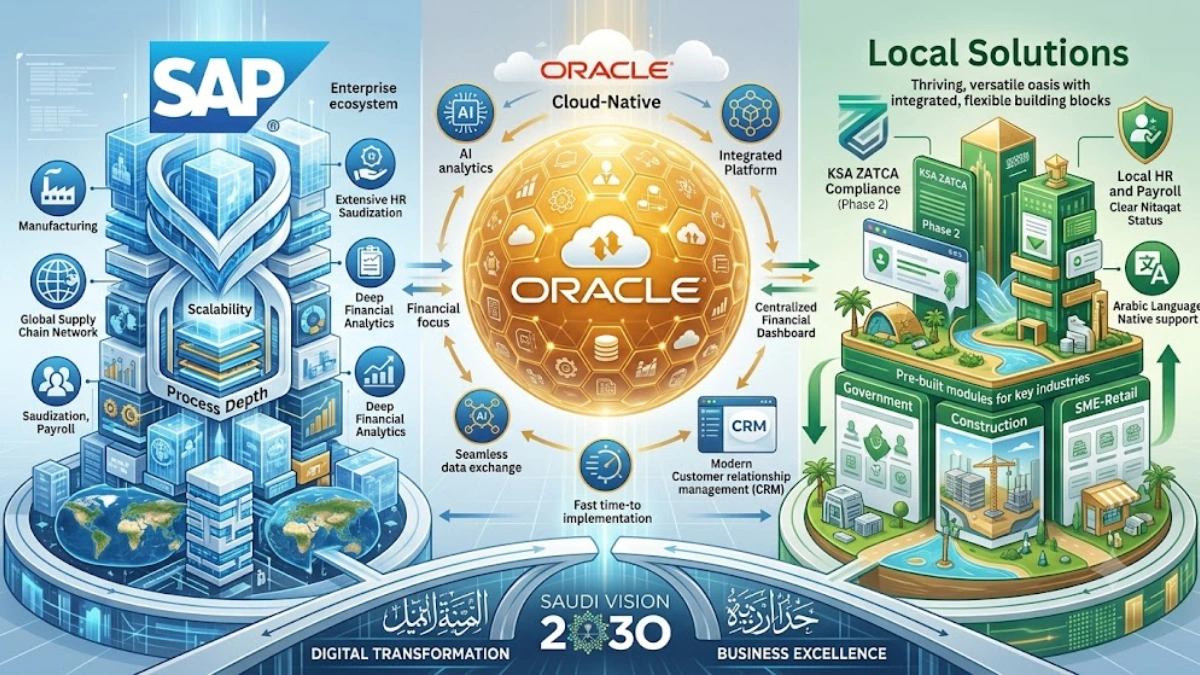
SAP vs Oracle vs Local ERP Solutions
| Feature | SAP | Oracle NetSuite | Local Saudi ERP |
|---|---|---|---|
| Best For | Large Enterprises | Growing Businesses | SMEs |
| Deployment | Cloud & On-Premise | Cloud-Based | Mostly Cloud |
| Arabic Support | Yes | Yes | Excellent |
| ZATCA Compliance | Strong | Strong | Native |
| Cost | Very High | High | Affordable |
| Customization | Advanced | High | Moderate |
| Setup Time | Long | Medium | Faster |
| Scalability | Excellent | Excellent | Moderate |
How to Choose the Right ERP in Saudi Arabia
Before selecting ERP software, businesses should evaluate:
Company Size
Large enterprises usually prefer SAP or Oracle, while SMEs often choose Odoo or local ERP systems.
Industry Requirements
Manufacturing companies need production-focused ERP tools, while retail businesses prioritize inventory and POS integration.
Budget
ERP pricing includes:
- Software licenses
- Cloud subscriptions
- Implementation fees
- Training costs
- Ongoing support
Compliance Support
Saudi businesses must ensure the ERP supports:
- ZATCA e-invoicing
- VAT reporting
- Arabic invoicing
- Local payroll rules
Scalability
The ERP should support future expansion without requiring a complete migration later.
FAQs
Which ERP software is most popular in Saudi Arabia?
SAP, Oracle NetSuite, Microsoft Dynamics 365, and Odoo are among the most popular ERP systems in Saudi Arabia. Local Saudi ERP solutions are also growing quickly because of ZATCA compliance and Arabic support.
Which ERP is best for small businesses in Saudi Arabia?
Odoo, ERPNext, Zoho, and local Saudi ERP platforms are good choices for small businesses because they offer lower implementation costs and easier deployment.
Is SAP better than Oracle ERP?
SAP is often preferred for large enterprises and manufacturing industries, while Oracle NetSuite is popular for cloud-based and fast-growing businesses. The better option depends on company size, budget, and business goals.
What is ZATCA compliance in ERP?
ZATCA compliance means the ERP system supports Saudi Arabia’s e-invoicing regulations, VAT reporting, QR code invoicing, and digital invoice storage requirements.
Are local Saudi ERP systems good?
Yes, many local Saudi ERP systems provide excellent Arabic support, local compliance features, and faster implementation compared to international ERP platforms.
Which ERP is best for manufacturing companies?
SAP and Infor CloudSuite are considered strong ERP options for manufacturing businesses because of their advanced production and supply chain management features.
Final Thoughts
ERP software has become essential for businesses operating in Saudi Arabia’s competitive and digitally transforming economy. From finance and inventory management to HR and compliance, ERP systems help organizations improve efficiency, reduce manual work, and make smarter business decisions.
Global ERP leaders like SAP and Oracle dominate the enterprise market with advanced capabilities and scalability. Meanwhile, local Saudi ERP solutions are becoming increasingly attractive for SMEs due to their affordability, Arabic-first design, and native ZATCA compliance.
The best ERP system depends on:
- Business size
- Industry needs
- Budget
- Compliance requirements
- Future growth plans
Companies that carefully evaluate these factors before implementation are more likely to achieve long-term success and operational efficiency with their ERP investment.