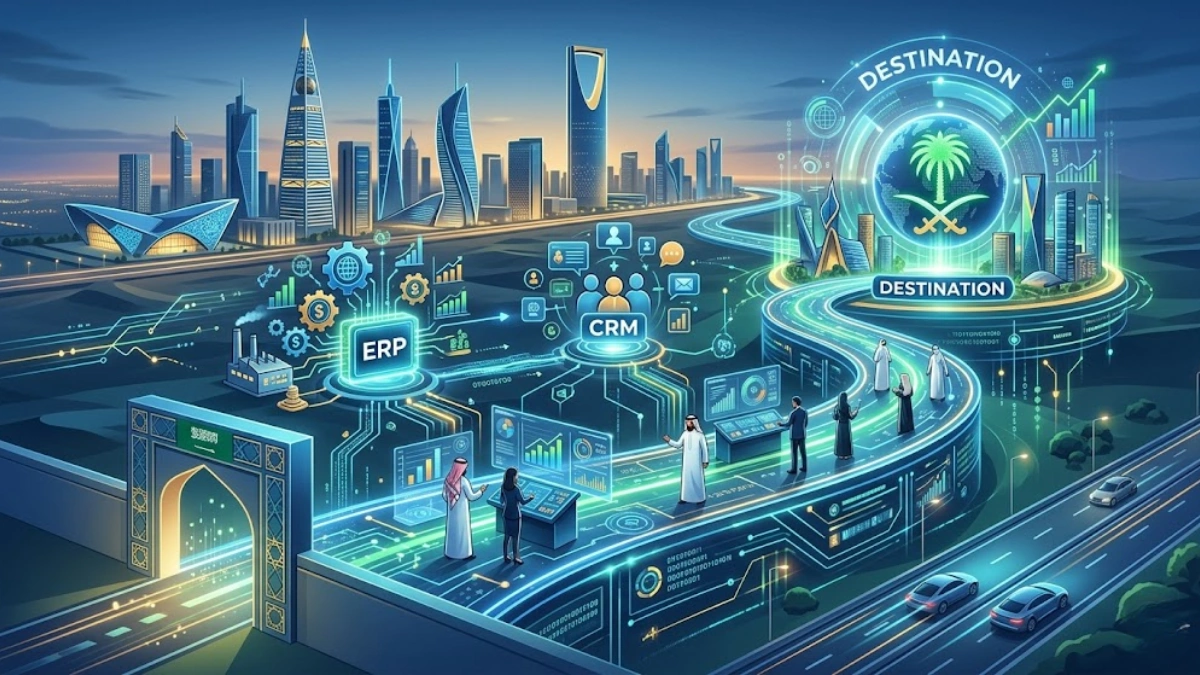
Saudi Arabia is undergoing one of the fastest enterprise modernization shifts in the Middle East, driven by Vision 2030, rapid cloud adoption, and strong government-backed digital initiatives. At the center of this transformation are two critical systems: ERP (Enterprise Resource Planning) and CRM (Customer Relationship Management).
For Saudi enterprises, digital transformation is no longer optional. It is the foundation for competitiveness, efficiency, compliance, and scalable growth. This roadmap explains how ERP and CRM work together to transform businesses from traditional operations into fully digital enterprises.
Understanding Digital Transformation in the Saudi Business Context
Digital transformation is not just about installing software. It is about rebuilding how a business operates, serves customers, and makes decisions using technology.
In Saudi Arabia, transformation is strongly influenced by:
- Vision 2030 economic diversification
- Rapid growth in e-commerce and retail
- Expansion of logistics and manufacturing sectors
- Increased VAT compliance requirements
- Cloud-first government policies
ERP and CRM systems are the core engines that power this transformation.
What is ERP in Digital Transformation?
ERP systems manage the internal backbone of a business. They integrate core functions into a unified digital system.
Leading ERP providers include:
- SAP
- Oracle
- Microsoft (Dynamics 365 ERP)
ERP Transforms These Areas:
- Finance and accounting automation
- Inventory and warehouse optimization
- HR and payroll digitization
- Procurement and vendor management
- Supply chain visibility
ERP ensures that all internal departments operate on one connected data system, eliminating silos and manual work.
What is CRM in Digital Transformation?
CRM focuses on the customer-facing side of digital transformation. It helps businesses attract, convert, and retain customers more effectively.
Top CRM platforms:
- Salesforce
- HubSpot
- Zoho
CRM Transforms These Areas:
- Sales pipeline automation
- Customer data centralization
- Marketing campaign management
- Customer service tracking
- Lead nurturing and conversion optimization
CRM helps businesses build stronger customer relationships and predictable revenue growth.
ERP vs CRM in Digital Transformation Strategy
| Aspect | ERP Role | CRM Role |
|---|---|---|
| Focus | Internal operations | Customer engagement |
| Goal | Efficiency & control | Revenue growth |
| Data | Financial & operational | Customer & behavioral |
| Users | Finance, HR, operations | Sales & marketing |
| Impact | Cost reduction | Sales increase |
Both systems are essential not competing, but complementary.
Why Saudi Enterprises Need Digital Transformation Now
Saudi enterprises face unique challenges and opportunities:
- Growing competition in GCC markets
- Increasing demand for digital customer experience
- Government compliance requirements (VAT, ZATCA systems)
- Expansion of e-commerce and online services
- Pressure to reduce operational costs
Companies that delay transformation risk falling behind more agile competitors.
ERP & CRM Integration: The Real Power of Transformation
The real digital transformation happens when ERP and CRM systems are integrated into a single ecosystem.
How Integration Works:
- CRM captures customer orders
- ERP processes inventory and fulfillment
- Finance system records revenue automatically
- Management dashboards show real-time performance
This creates a fully connected digital business flow.
Digital Transformation Roadmap for Saudi Enterprises
Phase 1: Assessment and Planning
Before implementing any system, businesses must evaluate:
- Current operational gaps
- Sales and customer challenges
- Financial reporting issues
- Departmental inefficiencies
At this stage, leadership defines whether ERP, CRM, or both are needed first.
Phase 2: Choosing the Right Systems
Saudi enterprises typically choose between:
ERP solutions:
- SAP
- Oracle
- Microsoft
CRM solutions:
- Salesforce
- HubSpot
- Zoho
Key decision factors:
- Business size
- Industry type
- Budget
- Scalability requirements
Phase 3: Implementation Strategy
ERP and CRM implementation requires structured execution:
- Data migration from legacy systems
- Employee training programs
- Workflow redesign
- Security and compliance setup
This phase is often the most complex and requires expert consulting.
Phase 4: Integration of ERP and CRM
This phase connects both systems into one ecosystem.
Benefits of Integration:
- Real-time sales and finance visibility
- Automated order processing
- Reduced manual errors
- Faster customer service response
- Better forecasting accuracy
Integration is the turning point in digital transformation maturity.
Phase 5: Automation and Optimization
Once systems are stable, businesses can introduce automation:
- Automated invoicing
- AI-based sales forecasting
- Customer segmentation
- Inventory demand prediction
- Workflow automation
This stage maximizes efficiency and reduces operational costs.
Phase 6: Advanced Analytics and AI Adoption
Saudi enterprises are increasingly moving toward AI-driven decision-making.
Advanced capabilities include:
- Predictive sales analytics
- Customer behavior analysis
- Demand forecasting
- Financial risk detection
- Performance dashboards
ERP and CRM become intelligent systems instead of static tools.
Benefits of ERP & CRM Digital Transformation in Saudi Arabia
1. Operational Efficiency
Automation reduces manual work and improves accuracy.
2. Revenue Growth
CRM improves lead conversion and customer retention.
3. Compliance Readiness
ERP ensures compliance with Saudi tax and reporting regulations.
4. Real-Time Decision Making
Managers can access live dashboards for faster decisions.
5. Scalability
Businesses can expand without operational chaos.
Challenges in Digital Transformation
Despite benefits, Saudi enterprises often face challenges:
- High implementation cost
- Resistance to change
- Lack of skilled workforce
- Data migration complexity
- Integration difficulties
These challenges can be managed with proper planning and training.
Best Practices for Successful Implementation
- Start with clear business objectives
- Choose scalable cloud-based systems
- Train employees thoroughly
- Integrate ERP and CRM early
- Use phased rollout strategy
- Monitor performance continuously
Future of ERP & CRM in Saudi Arabia
The future is moving toward:
- AI-powered ERP systems
- Intelligent CRM automation
- Fully cloud-based ecosystems
- Mobile-first business operations
- Real-time predictive analytics
Saudi Arabia is positioning itself as a regional leader in enterprise digital transformation.
FAQs: Digital Transformation with ERP & CRM
1. What is the main goal of ERP and CRM in digital transformation?
ERP improves internal operations like finance and inventory, while CRM focuses on improving customer relationships and increasing sales.
2. Do Saudi businesses need both ERP and CRM?
Yes, most growing Saudi enterprises eventually need both systems to manage operations and customer engagement efficiently.
3. Which should be implemented first, ERP or CRM?
If your business struggles with operations, start with ERP. If sales and customer management are weak, start with CRM.
4. Is cloud ERP better for Saudi enterprises?
Yes, cloud ERP is widely preferred due to scalability, lower cost, remote access, and easier updates.
5. How long does ERP and CRM implementation take?
CRM can take 1–3 months, while ERP usually takes 3–12 months depending on business size.
Conclusion
Digital transformation with ERP and CRM is not just a technology upgrade it is a complete business evolution. For Saudi enterprises, it means moving from fragmented systems to fully integrated, intelligent operations.
ERP builds the foundation. CRM drives growth. Together, they create a powerful digital ecosystem that supports long-term scalability, efficiency, and competitiveness in a rapidly evolving market. Businesses that adopt this roadmap early will be better positioned to succeed in the Vision 2030 economy.