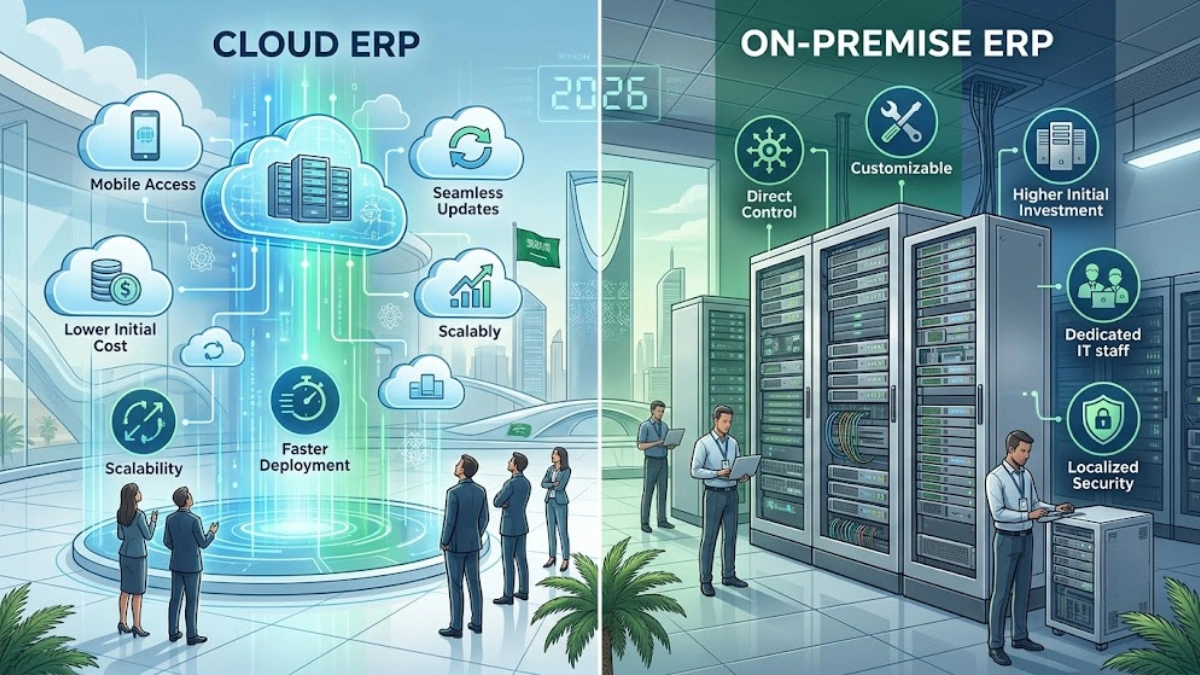
Saudi Arabian businesses are rapidly investing in ERP systems as digital transformation accelerates under Vision 2030. From retail and manufacturing to healthcare, logistics, and construction, companies are adopting ERP software to automate operations, improve reporting, and support ZATCA compliance.
One of the biggest decisions businesses face before ERP implementation is choosing between Cloud ERP and On-Premise ERP.
Both deployment models offer advantages and disadvantages depending on business size, budget, industry requirements, security concerns, and long-term growth plans.
This guide explains the differences between Cloud ERP and On-Premise ERP and helps KSA companies decide which option is best in 2026.
What Is Cloud ERP?
Cloud ERP is hosted on the vendor’s servers and accessed through the internet. Businesses pay monthly or yearly subscription fees instead of purchasing expensive hardware infrastructure.
The ERP provider handles:
- Server management
- Security updates
- System maintenance
- Software upgrades
- Cloud hosting
Employees can access Cloud ERP remotely from laptops, tablets, or smartphones.
Popular Cloud ERP platforms in Saudi Arabia include:
- SAP S/4HANA Cloud
- Oracle NetSuite
- Microsoft Dynamics 365
- Odoo Cloud
- Oracle ERP Cloud
What Is On-Premise ERP?
On-Premise ERP is installed on the company’s own servers and managed internally by the organization’s IT team.
Businesses are responsible for:
- Hardware infrastructure
- Security management
- Software maintenance
- Backup systems
- Server upgrades
Large enterprises with dedicated IT departments often choose On-Premise ERP for greater infrastructure control.
Common On-Premise ERP systems include:
- SAP ECC
- SAP S/4HANA On-Premise
- Oracle ERP
- Microsoft Dynamics On-Premise
Cloud ERP vs On-Premise ERP: Major Differences
| Feature | Cloud ERP | On-Premise ERP |
|---|---|---|
| Initial Cost | Lower | Higher |
| Deployment Time | Faster | Slower |
| Maintenance | Vendor Managed | Company Managed |
| Accessibility | Remote Access | Mostly Internal Access |
| Infrastructure | No Hardware Needed | Requires Servers |
| Updates | Automatic | Manual |
| Scalability | Easy | Complex |
| Customization | Moderate | Advanced |
| Security Control | Vendor Managed | Full Company Control |
| IT Team Requirement | Low | High |
Why Cloud ERP Is Growing in Saudi Arabia
Cloud ERP adoption in Saudi Arabia is increasing rapidly because businesses want:
- Lower implementation costs
- Faster deployment
- Remote accessibility
- Easier scalability
- Reduced IT infrastructure management
Saudi SMEs especially prefer Cloud ERP because it allows them to access advanced business software without investing heavily in servers and IT infrastructure.
Advantages of Cloud ERP
1. Lower Upfront Cost
Cloud ERP does not require expensive servers or hardware installations.
Businesses pay:
- Monthly subscriptions
- Annual licensing fees
- User-based pricing
This makes Cloud ERP more affordable for SMEs and startups.
2. Faster Implementation
Cloud ERP systems can often be deployed within weeks or months instead of long enterprise-level installation timelines.
Faster deployment helps businesses:
- Reduce downtime
- Start operations quickly
- Improve ROI faster
3. Remote Accessibility
Cloud ERP can be accessed from anywhere with an internet connection.
This is especially useful for:
- Multi-branch companies
- Remote teams
- Sales staff
- Business owners traveling frequently
4. Automatic Updates
Cloud ERP vendors regularly provide:
- Security patches
- Feature updates
- Compliance upgrades
- Performance improvements
Businesses do not need to manage updates manually.
5. Easier Scalability
Cloud ERP systems can easily support:
- Additional users
- New branches
- Increased transactions
- Business expansion
Companies can scale operations without major infrastructure upgrades.
Disadvantages of Cloud ERP
1. Ongoing Subscription Costs
Monthly subscription fees continue long term and may become expensive for larger organizations.
2. Limited Infrastructure Control
Businesses rely on vendors for:
- Server performance
- Data hosting
- Maintenance
- Security management
Some enterprises prefer full internal control over systems.
3. Internet Dependency
Cloud ERP requires stable internet connectivity for smooth operation. Poor internet performance can affect productivity.
Advantages of On-Premise ERP
1. Full Infrastructure Control
Businesses control:
- Servers
- Security policies
- Data storage
- Backup systems
This is important for companies with strict security requirements.
2. Advanced Customization
On-Premise ERP systems usually allow deeper customization for complex business processes. Large manufacturers and industrial companies often prefer this flexibility.
3. Internal Data Hosting
Some organizations prefer storing sensitive data internally rather than on third-party cloud servers. Industries like banking and defense may prioritize this approach.
Disadvantages of On-Premise ERP
1. High Initial Investment
Businesses must purchase:
- Servers
- Networking equipment
- Backup systems
- Software licenses
Implementation costs can become very high.
2. Expensive Maintenance
On-Premise ERP requires:
- IT teams
- Security monitoring
- System upgrades
- Hardware maintenance
These ongoing costs add significant operational expenses.
3. Longer Deployment Time
Complex installations and infrastructure setup may take several months or even years for enterprise projects.
Which ERP Option Is Better for KSA SMEs?
Most Saudi SMEs now prefer Cloud ERP because it offers:
- Lower upfront costs
- Faster deployment
- Easier scalability
- Minimal IT infrastructure requirements
Popular SME Cloud ERP choices include:
- Odoo
- Microsoft Dynamics 365
- Oracle NetSuite
- SAP Business One Cloud
Cloud ERP aligns well with Saudi Arabia’s growing digital economy and remote business operations.
Which ERP Option Is Better for Large Enterprises?
Large enterprises often choose On-Premise ERP or Hybrid ERP models because they require:
- Advanced customization
- Complex integrations
- Internal infrastructure control
- Industry-specific workflows
Industries commonly using On-Premise ERP include:
- Oil & gas
- Heavy manufacturing
- Government organizations
- Industrial production
However, even large enterprises are increasingly moving toward private cloud or hybrid ERP models in 2026.
Hybrid ERP: The Growing Trend in Saudi Arabia
Many KSA businesses are now adopting Hybrid ERP models that combine:
- Cloud flexibility
- On-Premise control
For example:
- Financial systems may remain on-premise
- CRM and HR modules may operate in the cloud
Hybrid ERP allows businesses to balance security, scalability, and cost efficiency.
ZATCA Compliance and ERP Selection
Saudi companies must ensure ERP systems support:
- ZATCA e-invoicing
- VAT reporting
- QR-code invoice generation
- Arabic invoicing
- Digital invoice storage
Most modern Cloud ERP and On-Premise ERP systems now offer ZATCA compliance modules.
Cloud ERP vs On-Premise ERP Cost Comparison
| Cost Factor | Cloud ERP | On-Premise ERP |
|---|---|---|
| Initial Investment | Low | Very High |
| Monthly Costs | Ongoing Subscription | Lower After Setup |
| Hardware Cost | Minimal | High |
| IT Staffing | Low | High |
| Maintenance | Included | Separate Expense |
| Upgrade Cost | Included | Additional Cost |
How to Choose the Right ERP Deployment Model
Choose Cloud ERP If:
- You are an SME or startup
- You want faster deployment
- You prefer lower upfront costs
- You have limited IT resources
- Remote accessibility is important
Choose On-Premise ERP If:
- You need full infrastructure control
- You require advanced customization
- Your business handles sensitive data
- You already have strong IT infrastructure
Choose Hybrid ERP If:
- You want both flexibility and control
- Different departments require different deployment models
- Your business is gradually migrating to the cloud
FAQs
Which is cheaper: Cloud ERP or On-Premise ERP?
Cloud ERP usually has lower upfront costs, while On-Premise ERP requires expensive hardware and infrastructure investment.
Why are Saudi SMEs choosing Cloud ERP?
Saudi SMEs prefer Cloud ERP because it offers affordability, faster deployment, remote access, and easier scalability.
Is Cloud ERP secure?
Modern Cloud ERP vendors provide strong security measures, encryption, backups, and compliance support. However, businesses must choose trusted providers.
Can On-Premise ERP support ZATCA compliance?
Yes, both Cloud and On-Premise ERP systems can support ZATCA e-invoicing and VAT reporting requirements.
What is Hybrid ERP?
Hybrid ERP combines cloud-based and on-premise systems to provide both flexibility and infrastructure control.
Which industries prefer On-Premise ERP?
Large manufacturing, oil & gas, government, and industrial companies often prefer On-Premise ERP because of customization and security requirements.
Final Thoughts
The Cloud ERP vs On-Premise ERP decision depends on business size, industry requirements, budget, security needs, and long-term digital strategy.
In 2026, most Saudi SMEs are expected to continue moving toward Cloud ERP because of:
- Lower implementation costs
- Faster deployment
- Better scalability
- Reduced infrastructure management
Meanwhile, large enterprises may continue using On-Premise or Hybrid ERP models for greater customization and control.
Businesses that carefully evaluate operational needs, compliance requirements, and future scalability goals will be better positioned to choose the right ERP deployment strategy in Saudi Arabia’s fast-growing digital economy.