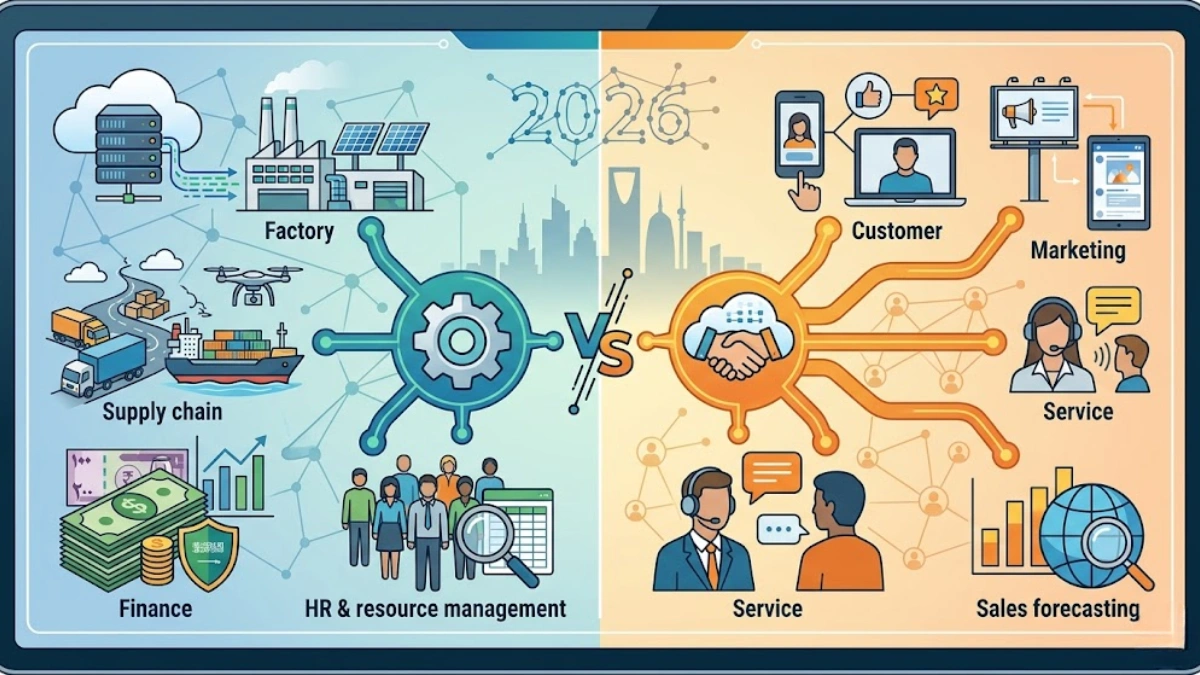
Saudi Arabia’s business environment is changing faster than ever due to Vision 2030, rapid digital transformation, and increasing competition in retail, logistics, construction, and service industries. In this shift, two software systems dominate business discussions: ERP (Enterprise Resource Planning) and CRM (Customer Relationship Management).
Many business owners think they must choose one. In reality, ERP and CRM solve different problems and the right choice depends on your business stage, size, and goals. This guide breaks everything down in simple terms with a clear comparison table, real Saudi use cases, and FAQs to help you decide confidently.
What is ERP (Enterprise Resource Planning)?
ERP is a centralized system that manages your internal business operations. It connects finance, HR, inventory, procurement, supply chain, and operations into one platform.
Major ERP providers:
- SAP
- Oracle
- Microsoft (Dynamics 365 ERP)
ERP Handles:
- Accounting and financial management
- Inventory and warehouse control
- Payroll and HR systems
- Procurement and supplier tracking
- Production and supply chain planning
ERP is the operational backbone of a company, ensuring everything runs smoothly behind the scenes.
What is CRM (Customer Relationship Management)?
CRM focuses on customers, sales, and marketing activities. It helps businesses track leads, manage customer interactions, and improve sales performance.
Popular CRM platforms:
- Salesforce
- HubSpot
- Zoho
CRM Helps You:
- Manage leads and sales pipelines
- Track customer communication history
- Automate marketing campaigns
- Improve customer service
- Increase conversions and retention
CRM is your growth engine, focused on increasing revenue and improving customer relationships.
ERP vs CRM: Key Comparison Table
| Feature | ERP System | CRM System |
|---|---|---|
| Focus | Internal operations | Customers & sales |
| Goal | Efficiency & cost control | Revenue growth |
| Users | Finance, HR, operations | Sales, marketing, support |
| Data Type | Financial & operational data | Customer & lead data |
| Main Benefit | Better control & accuracy | Higher sales & retention |
| Implementation | Complex & longer | Faster & simpler |
| Best For | Manufacturing, logistics, wholesale | Retail, real estate, services |
ERP vs CRM: Which One Should Saudi Businesses Choose First?
This depends on your biggest business challenge.
Choose ERP First If:
- Your accounting system is disorganized
- Inventory tracking is manual or inaccurate
- Departments are not connected
- You operate in manufacturing, trading, or logistics
- You need VAT compliance and financial accuracy
Example: A wholesale company in Dammam managing large inventory should start with ERP.
- You struggle with lead management
- Sales follow-ups are missed
- Marketing is not structured
- Customer relationships are weak
- You want faster business growth
Example: B real estate agency in Riyadh should prioritize CRM for managing clients and property inquiries.
ERP vs CRM: Detailed Business Comparison
| Category | ERP | CRM |
|---|---|---|
| Business Function | Operations management | Customer management |
| ROI Type | Cost savings | Revenue increase |
| Setup Time | 3–12 months | 1–3 months |
| Cost Level | High | Medium |
| Complexity | High | Moderate |
| Saudi Use Case | Logistics, manufacturing, retail chains | Real estate, e-commerce, services |
| Integration | Often connects with CRM | Often connects with ERP |
Why Saudi Businesses Are Using ERP + CRM Together
Modern companies in Saudi Arabia are moving toward integrated systems instead of choosing only one.
When ERP and CRM are connected:
- Sales data flows directly into finance
- Inventory updates reflect real-time orders
- Customer service becomes faster
- Management gets real-time dashboards
- Forecasting becomes more accurate
This integration is becoming standard in growing Saudi enterprises.
Cloud ERP vs Cloud CRM Trend in Saudi Arabia
Cloud adoption is growing rapidly because it supports scalability and flexibility.
Benefits of Cloud Systems:
- No heavy upfront infrastructure cost
- Access from anywhere in Saudi Arabia
- Automatic updates and security
- Easy scalability for growing businesses
Leading cloud solutions:
- Oracle Cloud ERP
- Microsoft Dynamics 365 Cloud
- Salesforce CRM Cloud
Benefits of ERP and CRM for Saudi Businesses
1. Strong Financial Control
ERP ensures accurate accounting and compliance with Saudi VAT regulations.
2. Better Sales Performance
CRM improves lead tracking and conversion rates.
3. Improved Customer Experience
Businesses can personalize communication and support.
4. Faster Decision Making
Real-time dashboards improve strategic planning.
5. Reduced Operational Costs
Automation reduces manual errors and inefficiencies.
FAQs: ERP vs CRM in Saudi Arabia
1. What is the main difference between ERP and CRM?
ERP manages internal business operations like finance and inventory, while CRM manages customer relationships and sales processes.
2. Which is better for small businesses in Saudi Arabia?
Small businesses usually start with CRM if they want to grow sales, or ERP if they need better financial control and inventory management.
3. Can ERP and CRM work together?
Yes. Many modern systems integrate ERP and CRM so data flows between sales, finance, and operations in real time.
4. Is ERP more expensive than CRM?
Yes. ERP systems are generally more expensive due to complexity and wider business coverage.
5. Which industries in Saudi Arabia need ERP the most?
Manufacturing, logistics, construction, wholesale trading, and large retail businesses benefit most from ERP systems.
6. Which industries benefit most from CRM?
Real estate, e-commerce, financial services, and service-based businesses rely heavily on CRM.
7. What are the top ERP and CRM providers?
Popular providers include SAP, Oracle, Microsoft, Salesforce, and Zoho.
8. Is cloud ERP safe for Saudi businesses?
Yes. Cloud ERP systems use advanced encryption and security standards and are widely adopted by enterprises in Saudi Arabia.
Final Decision Guide
Use this simple logic:
- Internal chaos → ERP
- Sales problems → CRM
- Growth + scaling → ERP + CRM together
Most medium and large Saudi businesses eventually need both systems integrated.