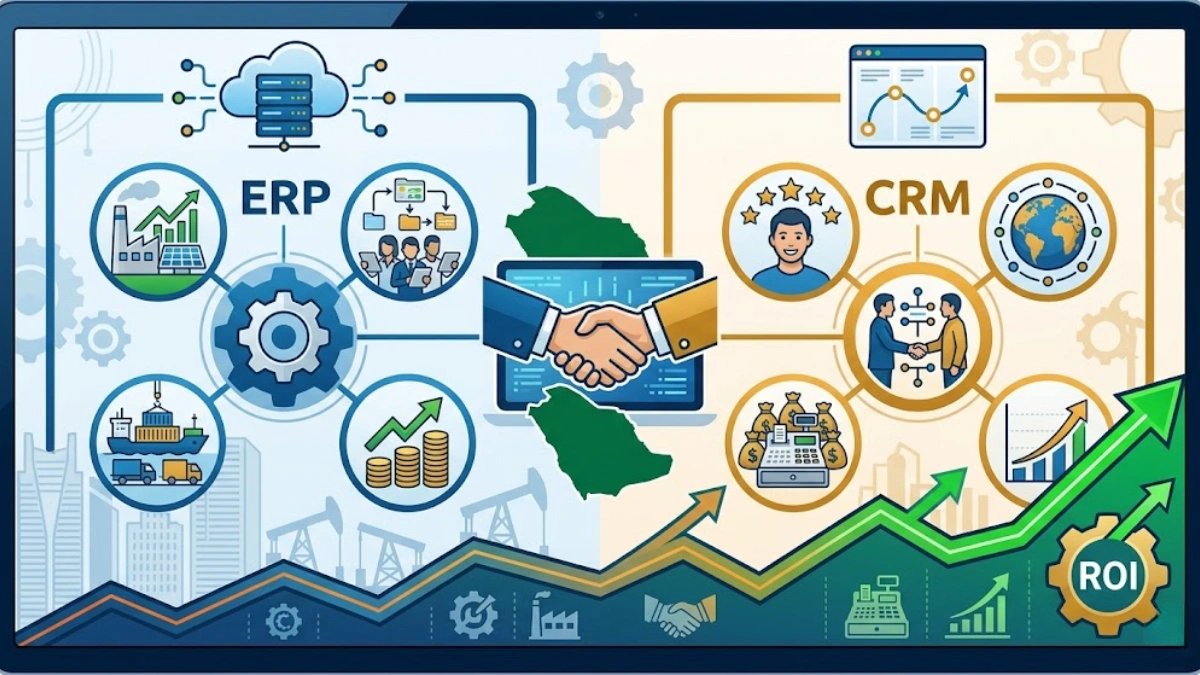
Saudi Arabia’s enterprises are accelerating digital transformation under Vision 2030, with major investments in ERP (Enterprise Resource Planning) and CRM (Customer Relationship Management) systems. But every decision-maker ultimately asks one question:
What is the real ROI of ERP and CRM implementation in Saudi businesses? This article explains ROI in practical terms, compares ERP vs CRM returns, and includes Saudi-focused case insights and structured tables for better decision-making.
What ROI Means in ERP and CRM Projects
ROI (Return on Investment) is not just profit. In ERP and CRM systems, ROI includes:
- Cost savings from automation
- Revenue growth from better sales systems
- Time saved in operations
- Reduced errors and rework
- Compliance efficiency (ZATCA/VAT in Saudi Arabia)
- Better decision-making speed
In most Saudi enterprises, ROI becomes visible within 6 to 36 months depending on system size and implementation quality.
Why ERP and CRM Deliver Strong ROI in Saudi Arabia
Saudi businesses experience higher ROI due to:
- Heavy reliance on manual processes in traditional companies
- Rapid expansion of retail, logistics, and manufacturing sectors
- Strong compliance requirements (VAT, ZATCA reporting)
- Growing competition in GCC markets
- Digital-first government policies
ERP reduces internal costs, while CRM increases revenue—creating a dual ROI effect.
ERP ROI in Saudi Arabia
ERP systems deliver ROI mainly through efficiency and cost reduction.
ERP ROI Drivers
- Automation of finance and accounting
- Inventory optimization
- Faster reporting cycles
- Reduced procurement waste
- Improved supply chain control
ERP is typically a cost-saving engine.
CRM ROI in Saudi Arabia
CRM systems deliver ROI through sales growth and customer retention.
CRM ROI Drivers
- Higher lead conversion rates
- Better sales tracking
- Automated marketing campaigns
- Improved customer retention
- Faster response times
CRM acts as a revenue acceleration system.
ERP vs CRM ROI Comparison Table
| ROI Factor | ERP Systems | CRM Systems |
|---|---|---|
| Primary Benefit | Cost reduction | Revenue growth |
| ROI Speed | Medium (12–36 months) | Fast (6–18 months) |
| Cost Savings | Very high | Medium |
| Sales Impact | Indirect | Direct |
| Operational Efficiency | Very high | Moderate |
| Best Industries | Manufacturing, logistics, retail chains | Real estate, e-commerce, services |
| Implementation Complexity | High | Medium |
Saudi ERP & CRM Case Study Insights
Case Study 1: Large Saudi Holding Company (ERP Transformation)
A diversified Saudi enterprise implemented ERP across finance, HR, and operations.
Before ERP
- Manual financial reporting
- Disconnected departments
- High operational costs
- Slow decision-making
After ERP
- Centralized data system
- Real-time financial reporting
- Reduced administrative workload
- Significant cost optimization
ROI Outcome
- Estimated 40–60% operational efficiency improvement
- Faster reporting cycles (days → hours)
Case Study 2: Saudi Manufacturing Company (ERP Optimization)
Challenges
- Inventory mismatches
- Production delays
- Manual procurement tracking
Results After ERP
- Real-time inventory visibility
- Reduced production downtime
- Improved supply chain efficiency
ROI Outcome
- Lower operational waste
- Improved production accuracy
Case Study 3: Saudi Service Business (CRM Adoption)
Before CRM
- Lost leads
- No structured follow-ups
- Weak customer tracking
After CRM
- Automated lead tracking
- Sales pipeline visibility
- Improved customer engagement
ROI Outcome
- 20–40% increase in conversion rates
- Faster sales cycle closure
ERP vs CRM ROI Summary Table (Saudi Market View)
| Category | ERP Impact | CRM Impact |
|---|---|---|
| Cost Reduction | High | Medium |
| Revenue Growth | Medium | High |
| Time Savings | High | Medium |
| Customer Impact | Low | Very High |
| Compliance Benefit | Very High | Low |
| ROI Timeline | 12–36 months | 6–18 months |
Combined ERP + CRM ROI Impact
When ERP and CRM are integrated, ROI increases significantly.
Key Benefits of Integration
- Seamless lead-to-invoice process
- Real-time financial visibility
- Faster order fulfillment
- Improved forecasting accuracy
- Reduced manual duplication
This integration creates a fully connected digital enterprise system.
Hidden ROI Benefits Often Missed
Many Saudi businesses underestimate indirect ROI:
- Reduced audit effort
- Lower compliance risk
- Faster executive decision-making
- Improved employee productivity
- Better interdepartmental coordination
These hidden gains often equal or exceed direct financial ROI over time.
ROI Challenges in ERP & CRM Projects
ROI can fail or delay due to:
- Poor user adoption
- Lack of employee training
- Weak implementation planning
- Data migration errors
- Over-customization of systems
Without proper execution, ROI timelines may extend beyond expectations.
How Saudi Businesses Can Maximize ROI
Best Practices
- Start with cloud-based ERP/CRM systems
- Focus on high-impact modules first
- Train employees properly
- Integrate ERP and CRM early
- Track KPIs continuously
- Use phased implementation approach
Cloud platforms from SAP, Oracle, Microsoft, and Salesforce are widely used in Saudi Arabia.
Future ROI Trends in Saudi Arabia
ERP and CRM ROI is expected to improve further due to:
- AI-powered automation
- Predictive analytics
- Cloud-first enterprise systems
- Mobile business operations
- Real-time dashboards and insights
Saudi Arabia is becoming a regional leader in enterprise digital ROI optimization.
FAQs
1. What is the average ROI of ERP in Saudi Arabia?
ERP ROI typically appears within 12–36 months depending on business size and implementation quality.
2. Does CRM provide faster ROI than ERP?
Yes. CRM often delivers faster ROI (6–18 months) due to direct impact on sales.
3. Which industries see the highest ERP ROI in Saudi Arabia?
Manufacturing, logistics, retail, construction, and large enterprises see the highest returns.
4. Can ERP and CRM work together for higher ROI?
Yes. Integration significantly increases efficiency and revenue performance.
5. What is the biggest factor affecting ROI?
User adoption and implementation quality are the most important factors.
Conclusion
ERP and CRM systems deliver strong ROI in Saudi Arabia when implemented strategically. ERP reduces operational costs and improves efficiency, while CRM increases sales and customer retention.
Real-world Saudi case studies show ROI ranging from 20% to over 60% improvement, especially when systems are integrated. For Saudi enterprises in 2026, ERP and CRM are not expenses they are long-term profitability engines.